Unemployment seemed to be the main focal point of 2025. The rise of AI and constant reports of graduates struggling to find jobs post-graduation has worried both students and the Fed. So much so, that the most recent rate cut was due to a weakening labor market more so than inflation being above their 2% target for the last 6 years. Despite the Feds attempts to ameliorate a softening labor market, the younger generation is still struggling.
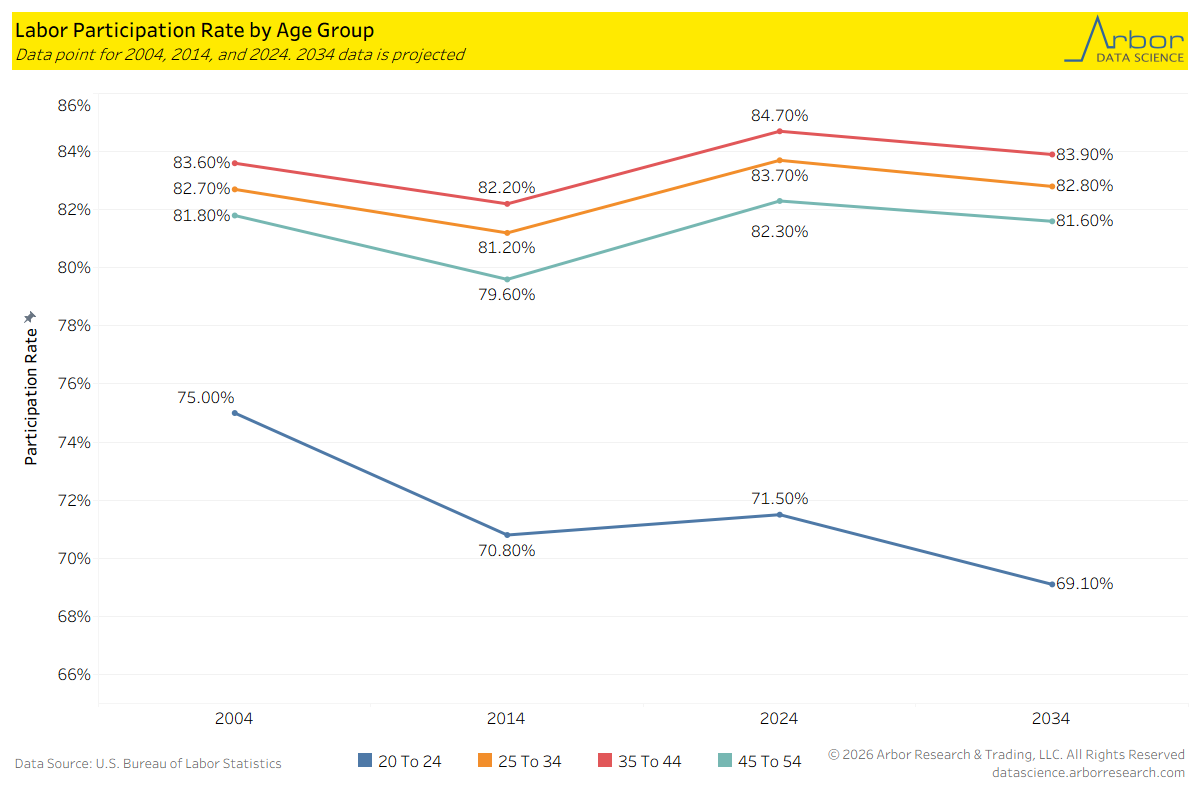
The chart below shows the labor participation rate for different age group ranges. It’s evident that the youngest age group (20-24) suffers from the least labor participation rate, though there are a few explanations for this; primarily, kids in this age range are still in school and therefore not part of the labor force. Still, a sizeable portion of them are likely looking for work and the trends paint a grim picture. Since 2004, their participation rate has dwindled from 75% down to 70.8% in 2014 with a small rebound to 71.5% in 2024. But it’s the projection for 2034 that is most dire: the rate is expected to drop under 70% while participation rates for other ages groups is expected to remain relatively stable.
Is it the rise of AI? The “less fire, less hire” mindset becoming mainstream? Something new that we won’t see coming? Regardless of whatever it may be, there’s no doubt that new graduates are hapless in the pursuit for their first “real” job.
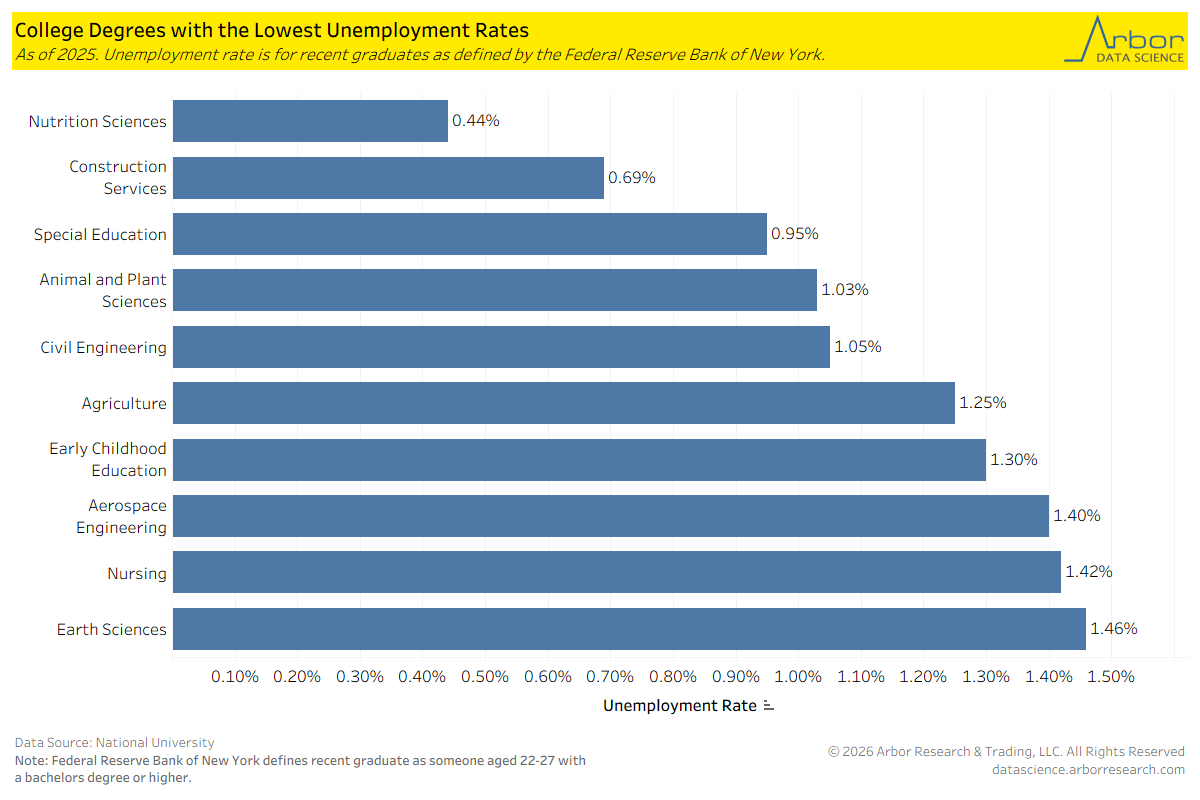
Some graduates are doing better than others though. Everyone has a friend in business or knows an engineering major who practically lives in the library, but how many people do you know understand the bioavailable of micronutrients? Or that dreaded noon energy crash is actually decided by what you eat for breakfast rather than lunch? That number may begin to increase as nutrition sciences majors have the lowest unemployment rate of any degree at only 0.44%, significantly smaller than the 5.8% unemployment for all recent college graduates. Other majors, like nursing and civil/aerospace engineering, have unemployment rates well below the 5.8%.
It’s interesting to note that there isn’t a “one size fits all” trend between these degrees. Regardless if you’re building rockets for NASA or helping an overworked parent lose some weight, you’re likely not worrying about losing your job. Even the threat of AI isn’t applicable to all degrees listed — though their low unemployment rates may stem from their irreplaceability by robots. Few homebuyers would trust AI to build their dream house and who knows what it would tell a child who just peed their pants. With all the talk about stressed out students looking for jobs months after graduating, alongside the “less hire, less fire” mindset that has been adopted by a preponderance of businesses, there might be a shift into these less populous majors and, inadvertently, an increase in supply for those sectors.
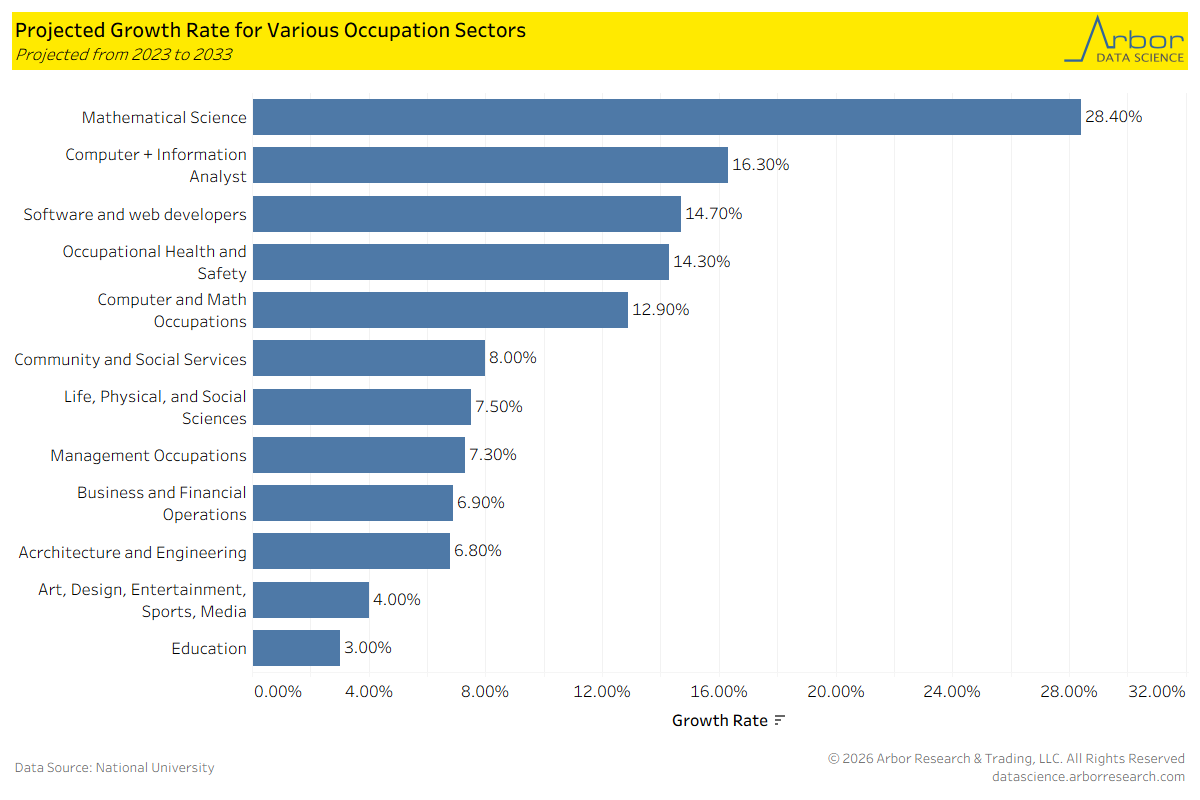
Different sectors will see varied growth rates for the next few years. The highest growth rate sectors are all STEM related: Mathematical Sciences, computer/information analyst, software developers, occupational health and safety, and computer/math occupations are all expected to have double digit growth rates. This coincides with the explosive growth in popularity of AI as more and more tech firms are looking to hire top STEM talent to propel them to the front of the AI arms race.
But these charts can’t be taken fully at face value. While STEM sectors appear to have healthy projected growth — and have always been popular — it’s likely contingent on the success of AI. If AI doesn’t deliver on it’s lofty promises, growth for these sectors may fall drastically, leaving students and early career professionals out to dry and exacerbating the “recent graduate unemployment” issue.
On the lower end, education, media, and business/finance, among others, see relatively low projections. Like mentioned previously, the popularity of AI may be dragging students away from these sectors and into the more high profile, high paying jobs that guarantee a better return on investment for their degrees. But these sectors have their own benefits too, even if it isn’t monetary. Teachers are always going to be in demand; people enjoy an creative ad or well drawn artwork; finance is as much gut feelings as it is technical analysis. In the “less hire, less fire” era we have ushered in, luxury doesn’t come from a high salary as much as it is peace of mind that a robot won’t replace you anytime soon.