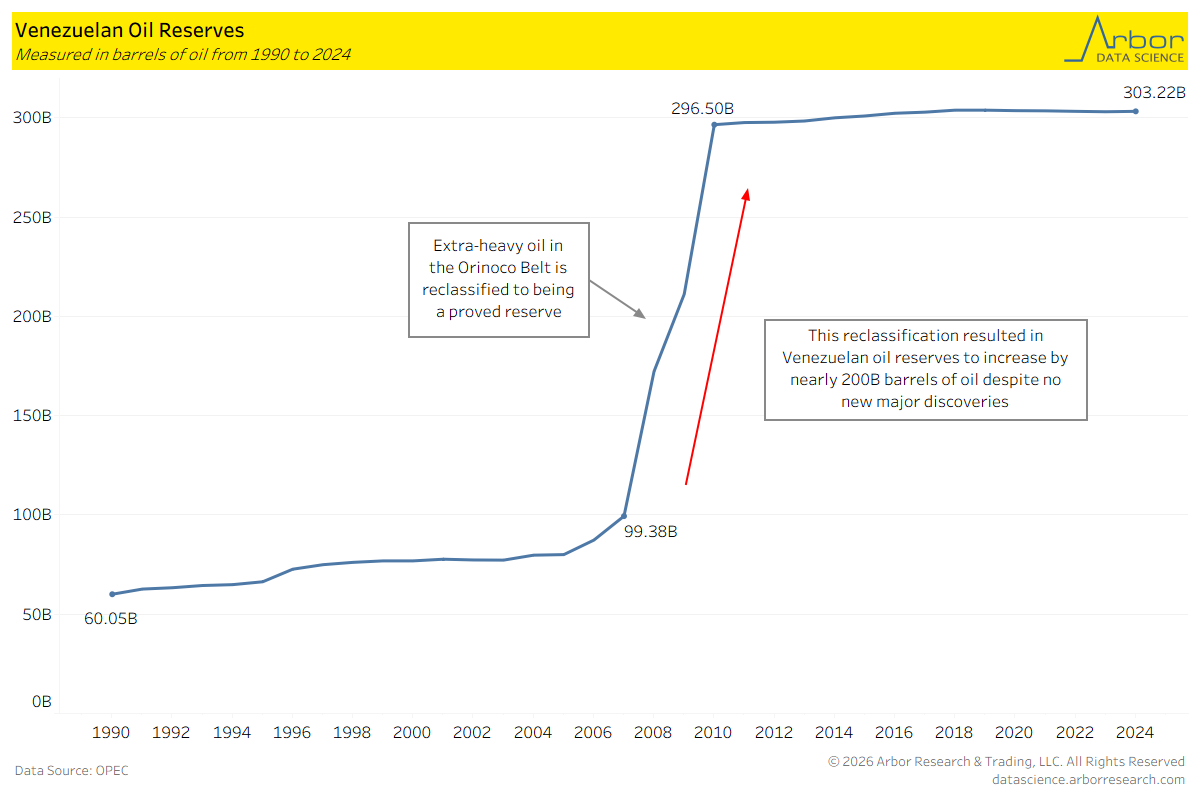
In the days since the U.S. captured President Nicolas Maduro, much has been written about the untapped oil reserves sitting beneath Venezuela. One reason for this abundance of coverage is the eye-popping level of Venezulean oil reserves. According to OPEC, the South American nation had approximately 303.22 billion barrels of oil beneath it’s surface as of 2024, the most of any nation.
However, there is a crucial caveat when discussing these reserves. In the late 2000s, Venezuela reclassified oil sitting in the Orinoco Belt as provable. Classifying oil as provable means that it is economically and technically viable to be extracted. This increased the levels of their reserves from 99.38 billion barrels in 2007 to 296.50 billion barrels in 2010. The oil in this region, which falls along the northeastern portion of the Orinoco River, is extremely viscous and heavy. This thicker crude requires more processing than the light crude found in western Texas to be of any use. Importantly, Venezuela is lacking in the needed refining infrastrucutre.
We can use American Petroleom Institute (“API”) gravity, which compares how light a petroleum liquid is to water, to examine the heaviness of oils found in different regions of the globe. The heavier the oil, the lower its degrees of API gravity. According to Anton Paar, three different types of oil found within Venezuela are heavier than oils drilled elsewhere in the world. Even the lightest oil found in Venenzuela measured by Anton Paar, Tia Juana Light, was heavier than its global peers. Boscan crude, which is found northwest of the Orinoco belt discussed above, has an API gravity of 10.1 degrees. The oil found within the Orinoco belt is classified as extra-heavy, a classification that means it has a API gravity below 10 degrees.

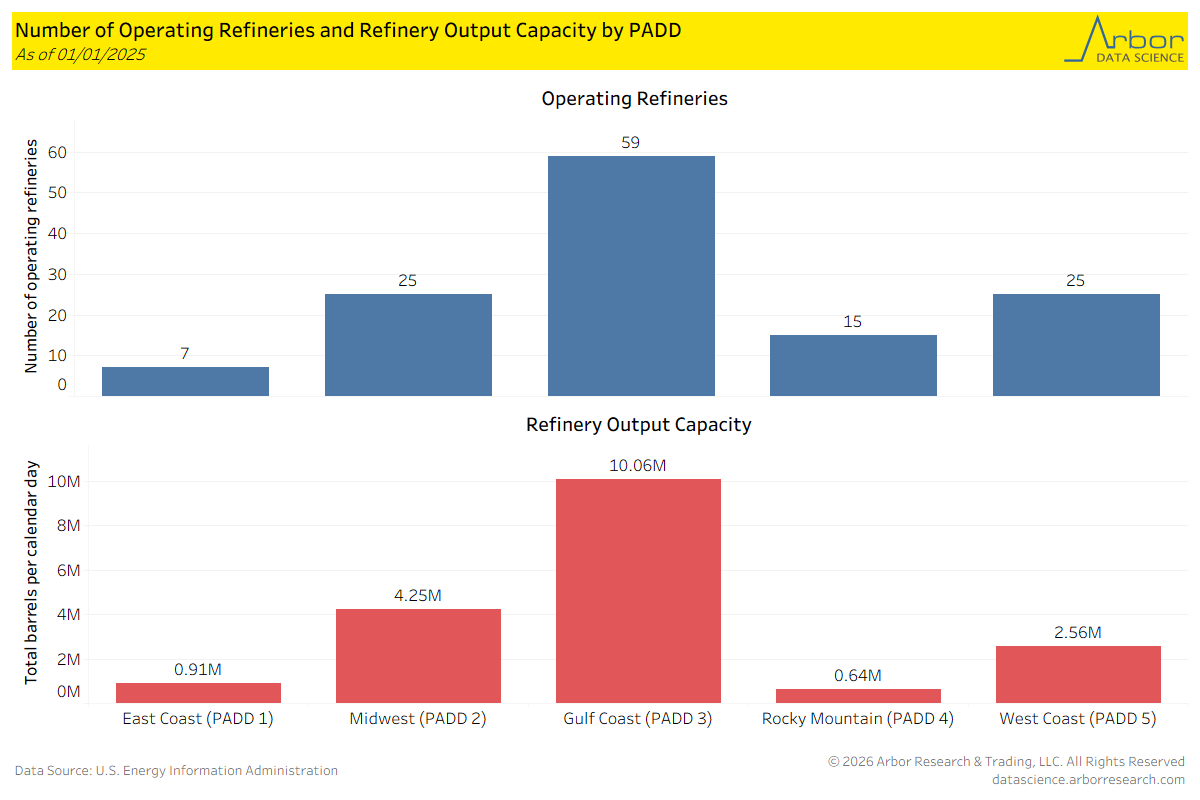
This is where the U.S. and its massive oil industry enters the picture. The U.S. has many oil refineries that were built to process this heavy crude oil into useful petro products. In fact, U.S. refineries already process much of the thick oil orginating from Canada’s tar sand fields located in Alberta. The Gulf Coast is home to almost half of the total refineries located across the five Petroleum Administraion for Defense Districts, and this region is the king of oil refining capacity.
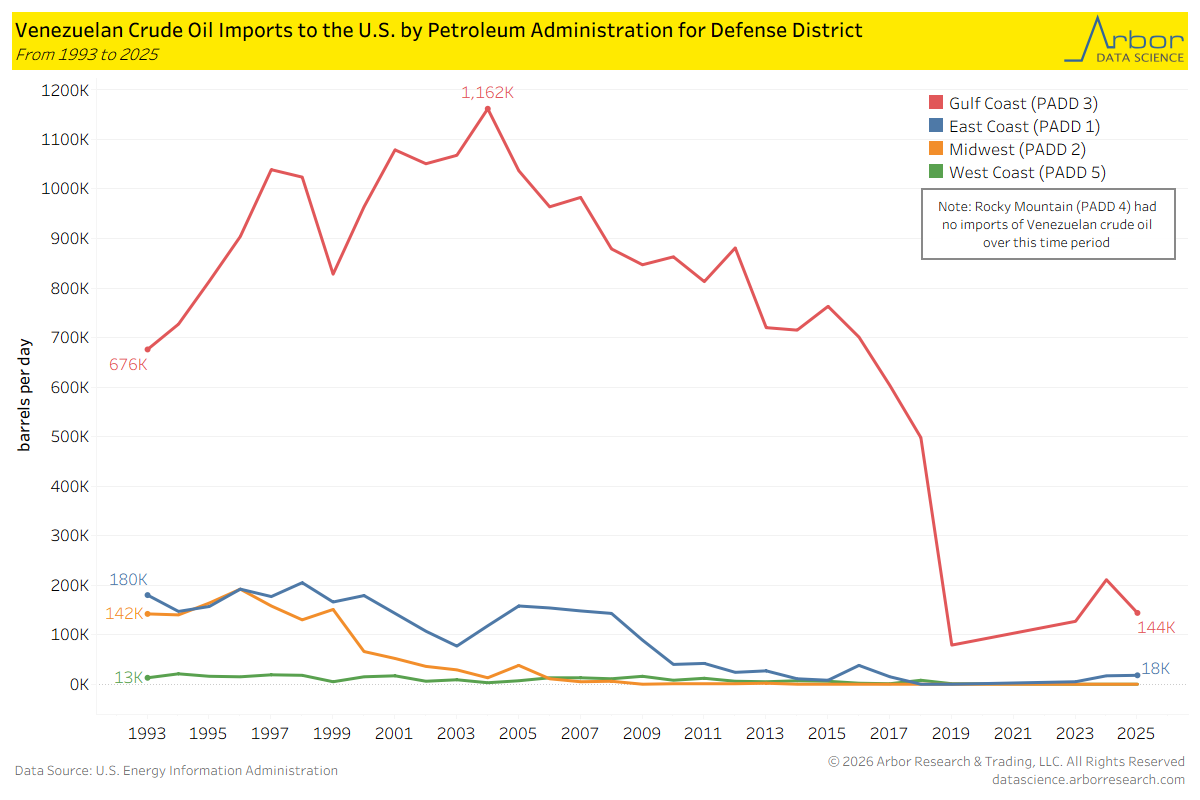
It is not suprising that a majority of Venezuelan oil imported into the U.S. arrived at the Gulf Coast because of its refining might. However, the number of barrels imported has fallen over the past two decades. In 2004, there was an average of 1.162 million barrels per day of Venezuelan oil arriving at the Gulf Coast. By 2025, that number was down to an average of approximately 144,000 barrels per day.
If the massive reserves of thick, Venezuelan oil are ever to be of use, it is likely that imports of oil into the Gulf Coast will rise back to levels seen during the early 2000s. If this crude oil arrives, the processing on U.S. soil could bring both lower oil prices as well as increased economic activity along the southern U.S. seaboard due to increased capital and hiring driven by elevated levels of refinement.